
Trestle Tables for Commercial Use — Buyer’s Guide
August 4, 2026
School Assembly Hall Furniture — Chairs, Tables & Moving Equipment
August 18, 2026Trestle Tables for Commercial Use — Buyer’s Guide
August 4, 2026School Assembly Hall Furniture — Chairs, Tables & Moving Equipment
August 18, 2026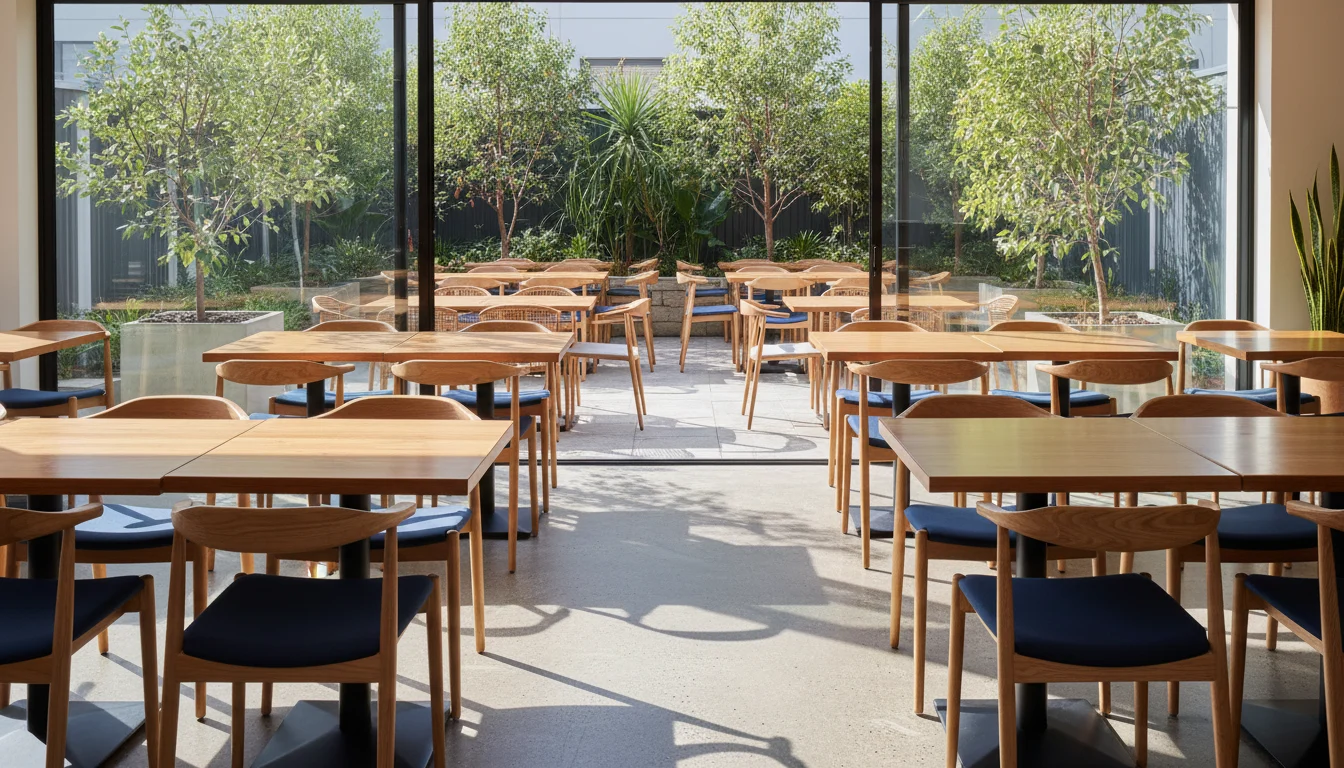
Cafe Furniture Australia: Choosing the Right Chairs & Tables
A practical guide for Australian cafe owners on balancing style, durability and space efficiency in high-traffic hospitality settings.
Why Cafe Furniture Needs to Balance Style, Durability and Practicality
Choosing furniture for your cafe is one of the most important fitout decisions you’ll make. Tables and chairs aren’t just aesthetic choices, they directly affect how many customers you can seat, how comfortable guests feel, how quickly staff can reset between sittings, and how long the furniture lasts under constant daily use.
Cafes operate across a wide range of environments: exposed alfresco decks, compact inner-city shopfronts, high-humidity beachside kiosks, and climate-controlled food courts. Each setting demands different materials, construction standards, and maintenance requirements.
This guide covers the three key decisions every cafe owner faces: selecting durable furniture for outdoor areas, maximising seating in small floor plans, and specifying furniture that can handle high-traffic service without deteriorating rapidly. All available at Innova Group’s cafe furniture range.
Guide to Choosing Durable Outdoor Cafe Furniture
Outdoor settings are the most demanding environment for cafe furniture. Exposure to UV, rain, humidity, salt air, and temperature swings accelerates wear on materials that perform perfectly indoors. Here’s how to choose correctly for Australian conditions.
Weather Resistance by Material
Not all outdoor furniture materials are the same. The table below compares the most common choices across key performance factors for Australian outdoor cafe use:
| Material | UV Resistance | Rust / Corrosion | Maintenance | Best For |
|---|---|---|---|---|
| Powder-coated steel | ✔ Good | Moderate: chips must be treated | Low: wipe down, touch up chips | Urban cafes, sheltered areas |
| Aluminium (anodised) | ✔ Excellent | ✔ Corrosion-proof | Very low | Coastal and beachside venues |
| Polypropylene (PP) plastic | Moderate: look for UV-stabilised grade | ✔ None | Very low: hose off | Budget-conscious, high turnover |
| Teak / hardwood | ✔ Excellent (oiled) | ✔ None | Medium: oil annually | Premium alfresco, boutique cafes |
| Resin wicker | Moderate: fade over time | ✔ None | Low | Resort-style, casual dining |
| Fibreglass / composite | ✔ Excellent | ✔ None | Very low | High-volume outdoor dining |
Key Features to Look For
- Sealed bases and footcaps: Exposed metal legs corrode from the ground up. Look for nylon or rubber foot caps and fully welded, sealed tube ends.
- Stackability: Outdoor chairs get moved constantly. Chairs that stack 8–12 high reduce storage space and damage during handling.
- Table top rating: Specify a table top with a certified outdoor-rated surface, HPL (High Pressure Laminate) rated for external use, or a solid aluminium/fibreglass top.
- Umbrella hole compatibility: If your outdoor area needs shade, choose tables with a pre-drilled umbrella pole hole (or a removable plug) rather than retrofitting.
- Weight and portability: Outdoor furniture is rearranged daily. Lightweight aluminium frames (under 5 kg per chair) dramatically reduce staff fatigue.
Maintenance Planning
Even the most durable outdoor furniture requires a simple maintenance schedule. At minimum, plan for:
- Weekly wipe-down with a mild detergent (avoid abrasive cleaners on powder coat)
- Annual inspection of all welds, fasteners, and foot caps
- Touch-up of any powder-coat chips before rust can take hold (for steel frames)
- Annual oiling for hardwood table tops and chair frames
- Storage or covering of cushioned seats during extended wet weather
Best Chairs & Tables for Cafes with Limited Floor Space
Many Australian cafes, particularly in CBD locations, laneways and heritage shopfronts, operate in tight footprints where every square metre counts. The right furniture selection can significantly increase your covers without compromising the guest experience.
Space-Saving Furniture Strategies
Compact Table Sizing
A 60 cm square table comfortably seats 2 and pushes two together for a party of 4. Drop the standard 70–75 cm square and gain up to 20% more covers in the same room.
Stackable Chairs
Stackable chairs can be cleared and stored in minutes for cleaning or events. Look for chairs rated to stack at least 8 high, it saves floor space and protects frames from damage. See our guide on stackable chairs for commercial settings.
Folding & Nesting Chairs
Folding chairs and nesting stools can be stored flat against a wall or in a compact rack when not in use, ideal for cafes that need to flex between cafe service and evening events.
Bar Stools & Counter Seating
A bar-height bench along a window or wall uses vertical space and eliminates the footprint of a table entirely, one stool per 40–50 cm of bench width vs. 60–70 cm for a chair-and-table configuration.
Pedestal Table Bases
A single pedestal base (rather than four legs) allows chairs to be pulled in from any angle and reduces trip hazards in tight circulation paths. Weighted cast-iron bases provide stability on uneven surfaces.
Modular Bench Seating
Fixed or semi-fixed banquettes along one wall free up the aisle and allow flexible table configurations in front, this is a common layout in European-style cafes and increasingly popular in Australia.
Recommended Furniture Dimensions for Small Cafes
| Item | Compact Spec | Seats / Cover | Notes |
|---|---|---|---|
| Square bistro table | 600 × 600 mm | 2 covers | 2 × together = 4 covers, 1200 mm table |
| Round table | Ø 600 mm | 2 covers | Easier circulation than square |
| Cafe chair (seat width) | 410–430 mm wide | 1-2 cover | Slim profile; allow 500 mm per seat minimum |
| Bar stool (window bench) | 40–45 cm per stool | 1 covers | No table footprint needed |
| Communal table | 1800 × 800 mm | 8 covers | High covers-per-sqm for solo diners |
How to Choose Durable Cafe Furniture for High-Traffic Seating Areas
A busy cafe might turn a table 8–12 times per day, seven days a week. Over a year, that’s thousands of uses per chair, and in a high-volume environment, furniture failure isn’t just a cost; it’s a safety and liability issue. Here’s how to spec correctly from the start.
Frame Strength and Construction
- Steel tube gauge: For commercial use, look for 16-gauge (1.6 mm wall) minimum on round tube frames. 14-gauge is better for very high traffic. Thinner gauges flex under load and fatigue at welds.
- Weld quality: MIG or TIG welded joints are the standard for commercial chairs. Avoid pressed or glued joints at connection points, they fail first under repeated dynamic loading.
- Glide type: Specify glides with a bolt-on (not press-in) design so they can be replaced without replacing the chair.
- Weight rating: Commercial chairs should be rated to at least 120 kg static load. For public-facing venues, 150 kg or higher is preferable to reduce warranty claims and liability exposure.
Seat Material by Use Case
| Seat Material | Durability | Clean-Up | Comfort | Best For |
|---|---|---|---|---|
| Polypropylene (moulded PP) | ✔ Excellent | ✔ Wipe clean instantly | Moderate | High-turnover cafes |
| Upholstered vinyl (PU/PVC) | ✔ Good | ✔ Wipe clean | High | Dine-in cafes, brunch venues |
| Fabric upholstered | Moderate: stains, wears | ✘ Difficult | Highest | Low-traffic, premium venues |
| Timber seat (solid) | ✔ Good: refinishable | ✔ Easy | Moderate | Restaurant, casual dining |
| Plywood (veneer) | Moderate: edges chip | ✔ Easy | Good | Mid-market, light traffic |
High-Traffic Specification Checklist
- Minimum 120 kg static weight rating (150 kg preferred for public venues)
- Commercial-grade steel frame: 16-gauge or better, fully welded joints
- Bolt-on rubber or nylon floor glides, replaceable without tools
- Non-porous seat surface (moulded PP or PU vinyl) for fast clean-up between covers
- Stackable design (8+ high) to allow daily storage and floor cleaning
- Table base: minimum star base, cast-iron or heavy-gauge steel for pedestal bases
- Table top: minimum HPL or composite, solid surface, or solid timber
- Supplier warranty: minimum 2-year commercial warranty on frame and joints
Related Reading
For venues that also host events, functions or private dining, our guides on hospitality furniture for hotels and restaurants and commercial stackable chairs cover the overlap between cafe and event-style seating requirements.
Frequently Asked Questions
Ready to Specify Your Cafe Furniture?
Innova Group supplies commercial-grade cafe chairs and tables across Australia, durable, space-smart options for indoor and outdoor settings in high-traffic hospitality environments.